
Stock Plan Administration: What It Is and When to Outsource It
What you'll learn in this article:
What stock plan administration actually involves
Why the operational complexity is higher than most teams expect
How to decide when to keep it in-house vs. outsource
What to look for in an outsourced stock plan partner
If your finance or HR team is tracking equity grants in a spreadsheet or relying on a generalist to manage a function that's grown well beyond what a generalist should own, you're not alone. Stock plan administration is one of the most consistently underresourced functions in corporate finance, at companies of every size.
This guide covers what stock plan administration actually involves, why the complexity is usually higher than expected, and how to evaluate whether keeping it in-house still makes sense for your company.
What Is Stock Plan Administration?
Stock plan administration is the operational work required to manage employee equity: tracking grants, processing exercises, handling vesting schedules, generating tax documents, and keeping cap table records accurate over time.
It sits at the intersection of HR, finance, and legal. And while it sounds like back-office bookkeeping, the stakes are high: errors in stock plan administration can result in 409A valuation problems, incorrect 83(b) election filings, disqualified ISO treatment, or cap table discrepancies that surface badly during audits, transactions, or regulatory reviews.
For companies in earlier stages, this work is often handled informally — a spreadsheet here, a Carta upload there. As headcount grows, grants multiply, employees leave, options get exercised, and the complexity compounds fast. And for public companies, the regulatory obligations are even more demanding: Section 16 reporting, proxy statement disclosures, and strict SEC compliance timelines add layers that require dedicated expertise.
What Does Stock Plan Administration Include?
A complete stock plan administration function typically covers:
Grant management: issuing new option grants, RSUs, or warrants; recording board approvals; maintaining grant agreements
Vesting schedule tracking: monitoring cliff and ratable vesting, flagging upcoming accelerations, handling departure scenarios
Exercise processing: coordinating cashless, cash, or early exercises; calculating spreads; issuing shares
Tax compliance: generating Form 3921 and 3922 filings, tracking ISO disqualifying dispositions, documenting ESPP transactions
409A coordination: managing valuation cadence and ensuring grant prices are properly documented
Cap table reconciliation: keeping equity records in sync with your equity management platform (Carta,Qapita,Shareworks,Equity Edge Online,Certent,Computershare,Fidelity, and Schwab EquiView)
Employee communications: sending grant notices, answering equity questions, providing year-end tax summaries
Regulatory reporting: Section 16 filings, proxy disclosures, and other compliance obligations for public or pre-IPO companies
The scope expands further once you layer in secondary transactions, tender offers, ESPP administration, or the exit process. What starts as a few dozen grants can become thousands of records across multiple equity classes, all requiring audit-ready documentation.
Why Stock Plan Administration Is More Complex Than It Looks
Many companies underestimate the operational burden of running a stock plan until something goes wrong. The complexity scales with headcount, equity instrument variety, and transaction volume, but even lean programs carry meaningful compliance obligations.
Rapid headcount changes create ongoing obligations
Every departure triggers a vesting cutoff calculation, a post-termination exercise window that must be tracked, and potential tax form obligations. Miss one, and you're dealing with disgruntled former employees, IRS notices, or inaccurate equity records that surface during the next financing or audit.
409A timing creates compliance pressure
Every new option grant must be priced at or above fair market value as of the grant date. Companies that issue grants frequently, whether after fundraising rounds, during annual refresh cycles, or as part of M&A, need current 409A valuations and the documentation to prove it. Timing gaps create compliance risk that's difficult to remediate after the fact.
Multiple equity instruments require specialized tracking
Modern equity programs often involve common stock, preferred stock, options, RSUs, warrants, SAFEs converting to equity, ESPP shares, and secondary transactions, each with distinct tax treatment, vesting mechanics, and reporting requirements. Tracking them all accurately requires systems and expertise that most finance generalists don't have.
Public company obligations add a separate layer
For public companies, stock plan administration extends into SEC reporting territory: Section 16 officers must file Form 4s within two business days of a transaction, proxy statements require detailed equity award disclosures, and ESPP programs carry their own compliance timelines. The margin for error is narrow and the visibility is high.
Due diligence and audits require pristine records
Whether you're heading into a financing round, an acquisition, an IPO, or a routine audit, your cap table and equity records will be scrutinized. Discrepancies, missing board approvals, or undocumented exercises don't just slow the process, they can erode deal value or require costly remediation.
In-House vs. Outsourced: How to Decide
There's no universal answer, but there are clear signals that outsourcing makes sense for a wide range of companies, from growing private companies to established public ones.
| Dimension | In-House | Outsourced (e.g., Countsy) Recommended for most companies |
|---|---|---|
| Cost | ✕ $80K–$120K+/yr for a dedicated hire; hidden costs in onboarding, benefits, and equity | ✓ $1,500–$6,000/mo depending on company size and scope; predictable and scalable |
| Expertise depth | ✕ Varies widely; most finance generalists lack specialized equity administration experience | ✓ Dedicated equity specialists with multi-company experience across startup stages |
| Tax compliance (3921/3922) | ~ Possible, but error-prone without a specialist; easy to miss deadlines | ✓ Included as standard; preparation and filing handled end-to-end |
| 409A coordination | ~ Typically managed ad hoc; timing gaps create compliance risk | ✓ Proactive scheduling with documentation to support every grant date |
| Cap table accuracy | ✕ Higher error risk with manual tracking; reconciliation burden falls on finance team | ✓ Direct work in Carta/Qapita with ongoing reconciliation and audit readiness |
| Employee equity support | ✕ HR or finance fields equity questions with limited bandwidth; inconsistent responses | ✓ Defined SLAs for employee inquiries; specialists answer grant and tax questions accurately |
| Due diligence readiness | ~ Depends heavily on how well records were maintained; often requires scrambling | ✓ Audit-ready documentation maintained continuously; no last-minute cleanup needed |
| Scalability | ✕ Adding headcount = proportionally more equity work; may require additional hire | ✓ Scales with your company; no need to hire or retrain as grant volume grows |
The economics of outsourcing are often more favorable than they appear. A dedicated in-house equity specialist commands $80K–$130K+ in base salary, plus benefits, management overhead, and the learning curve of ramping someone on your specific program. An experienced outsourced partner brings institutional knowledge, established workflows, and software fluency from day one.
Beyond cost, there's a coverage question: equity events don't wait for business hours, and single-person in-house functions create key-person risk. Outsourced providers offer team depth and continuity that's difficult to replicate internally.
What to Look for in an Outsourced Stock Plan Administration Partner
The right partner depends on your company's stage, equity program complexity, and what's currently breaking down. When evaluating options, prioritize:
Experience at your company stage and type
Ask for their client mix and look for range. A provider who works exclusively with one company type (all startups, or all large-cap public companies) may not have the versatility your program needs, especially if you're heading toward an IPO or acquisition. Countsy works with private companies, growth-stage companies, and public companies, and structures engagements to match where you are right now.
Cap table platform fluency
Your provider should work natively in your equity management platform, whether that's Carta, Qapita, or another tool, not just consume exports. Platform fluency matters because most of the compliance risk lives in the details: grant dates, share class accuracy, vesting cliff calculations. Countsy works natively in Carta,Qapita,Shareworks,Equity Edge Online,Certent,Computershare,Fidelity, and Schwab EquiView.
Tax form ownership
Confirm they handle Form 3921/3922 preparation and filing, not just the data tracking. Many providers stop short of actually filing, leaving you to scramble in January. For public companies, confirm coverage of Section 16 reporting as well.
Integration with your broader finance function
Stock plan administration doesn't exist in isolation. Your equity data feeds your cap table, your 409A, your financial statements, and your board or investor reporting. A strong outsourced partner integrates with your finance team or operates as an extension of it, rather than creating a siloed function.
Defined SLAs and employee-facing communication
Equity questions don't keep business hours. Employees ask about their grants when they're considering leaving, going through a life event, or filing taxes. Make sure your partner has defined response times and a clear communication protocol for employee-facing inquiries.
How Countsy Handles Stock Plan Administration
Countsy provides outsourced equity and stock plan administration as part of an integrated finance function, serving private companies, growth-stage businesses, and public companies alike. Our clients range from Series A startups to established public companies — the common thread is a need for experienced equity administration without the overhead of building and maintaining a fully in-house team.
What we handle:
Grant issuance, documentation, and board approval tracking
Vesting schedule management and departure processing
Exercise coordination and cap table reconciliation
409A valuation scheduling and documentation support
Form 3921/3922 preparation and filing
Section 16 reporting for public company clients
Employee equity education and question support
Carta,Qapita,Shareworks,Equity Edge Online,Certent,Computershare,Fidelity, and Schwab EquiView platform management
We operate on NetSuite as our financial platform backbone, giving clients a seamless connection between equity activity, financial reporting, and tax preparation. Our team handles the full equity administration lifecycle, so your finance and legal leads can focus on the work that moves the business forward.
Interested in learning more? See how Countsy works with companies at your stage.
FAQ
What is stock plan administration?
Stock plan administration is the operational management of a company's employee equity program, including tracking grants, processing vesting and exercises, generating tax documents, and maintaining accurate cap table records. It applies to private companies, pre-IPO companies, and public companies alike.
What does a stock plan administrator do?
A stock plan administrator manages the day-to-day mechanics of your equity program: issuing grants, tracking vesting schedules, processing option exercises, coordinating 409A valuations, preparing Form 3921/3922 filings, handling Section 16 reporting (for public companies), and answering employee equity questions.
When should a company outsource stock plan administration?
Most companies should consider outsourcing once equity administration is consuming meaningful time from finance or HR staff who have other priorities, or when compliance obligations (tax filings, 409A documentation, regulatory reporting) are at risk of falling through the cracks. For private companies, this often happens around 20+ equity holders or after a major financing. For public companies, the complexity justifies dedicated support from day one.
How much does outsourced stock plan administration cost?
Costs vary by provider, company size, and scope of services, but outsourced equity administration typically ranges from $1,500–$6,000/month for private companies and more for public companies with Section 16 obligations and larger grant volumes. In most cases, this is significantly less than the fully-loaded cost of a dedicated in-house specialist.
What's the difference between stock plan administration and equity administration?
The terms are often used interchangeably. "Stock plan administration" tends to refer specifically to option plan and RSU plan mechanics, while "equity administration" is broader and may include cap table management, secondary transactions, and board reporting. Countsy handles both.
What software do stock plan administrators use?
The most common platforms are Carta and Qapita for cap table and equity management. These integrate with HRIS systems, financial platforms like NetSuite, and transfer agents. The right provider will work natively in your equity platform and integrate with your broader financial stack.
Ready to Simplify Your Equity Administration?
Stock plan administration is one of those functions that's easy to underprioritize until an incorrect 409A, a missed exercise window, a late Form 3921 filing, or a cap table discrepancy during due diligence creates a problem that costs real time and money to fix.
Countsy provides equity administration as part of an integrated outsourced finance function, working with private, growth-stage, and public companies. We handle the full lifecycle — so your team doesn't have to.
Related reading:
Highlights and jump links
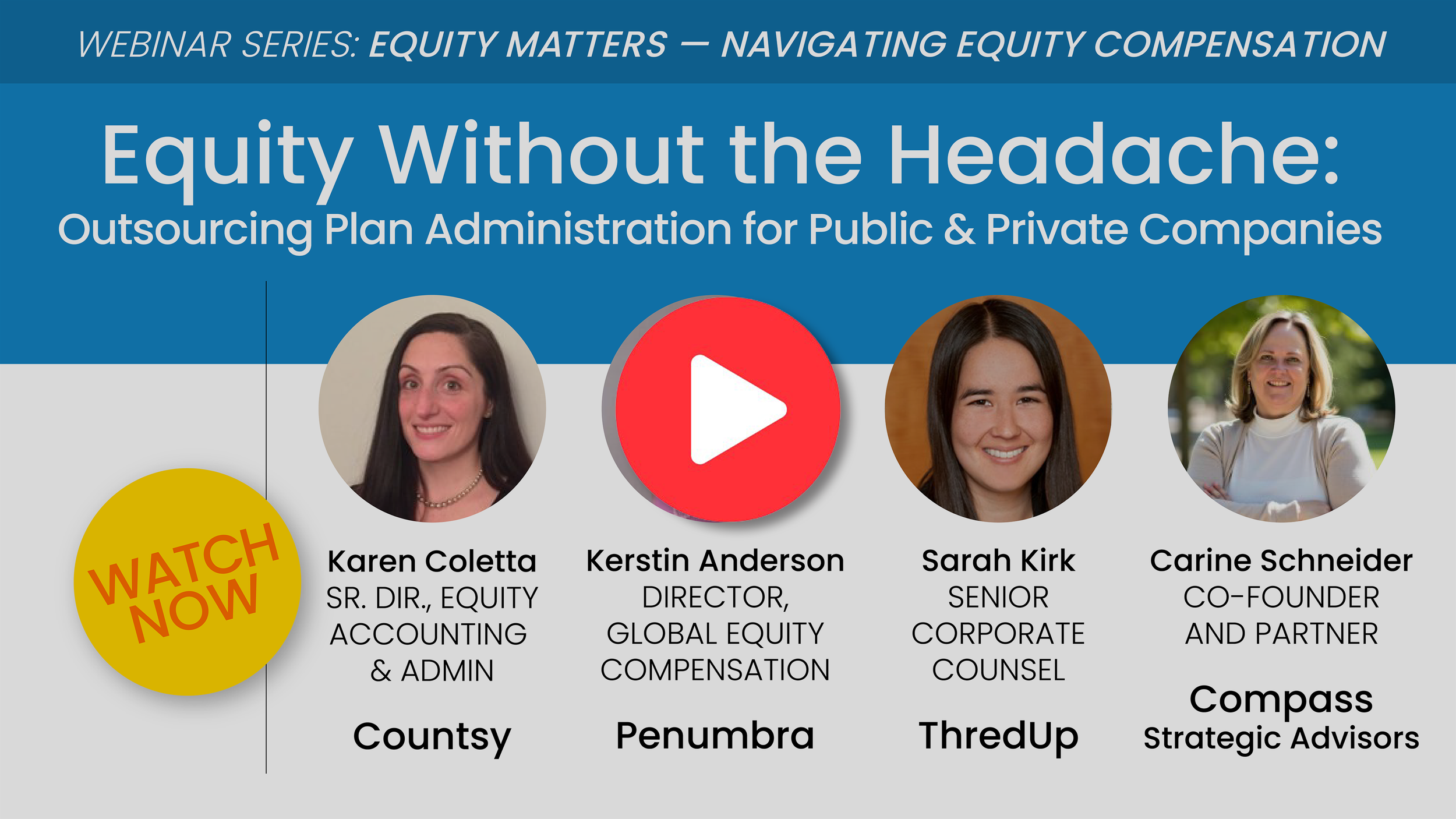
Use these jump links to watch the most relevant parts of the webinar. Each link opens the YouTube video at the exact moment.
00:00 — Session intro + who’s speaking
01:45 — Penumbra overview + equity plan basics (RSUs, PSUs, ESPP)
03:28 — thredUP overview + plan setup (public company stock plan operations)
04:17 — What Countsy does in outsourced equity administration
05:09 — Why outsource: IPO readiness, cost, scale, and controls
07:44 — Segregation of duties + audit/internal controls benefits
11:37 — ESPP design + Penumbra’s international “rebate” approach
13:28 — thredUP equity scope + board equity + cross-functional coordination
15:17 — Driving employee participation + equity education at scale
19:29 — “If I’m considering outsourcing, what should I evaluate?”
22:10 — Report accuracy + how to trust the data
24:21 — Legal perspective: SEC filings, proxies, 10-K backup
26:14 — Forfeiture rate analysis + expensing workflow
28:16 — Private companies + IPO timing (6–9 months ahead)
30:59 — January compliance reminder: Forms 3921 & 3922